Understanding Type Casting in Java: A Comprehensive Guide
Type casting is a fundamental concept in Java that allows you to convert one data type into another. This guide will explore the different types of casting, their use cases, and best practices with practical examples.
What is Type Casting?
Type casting is the process of converting a value from one data type to another. In Java, casting can be performed between primitive data types and between objects that share an inheritance relationship.
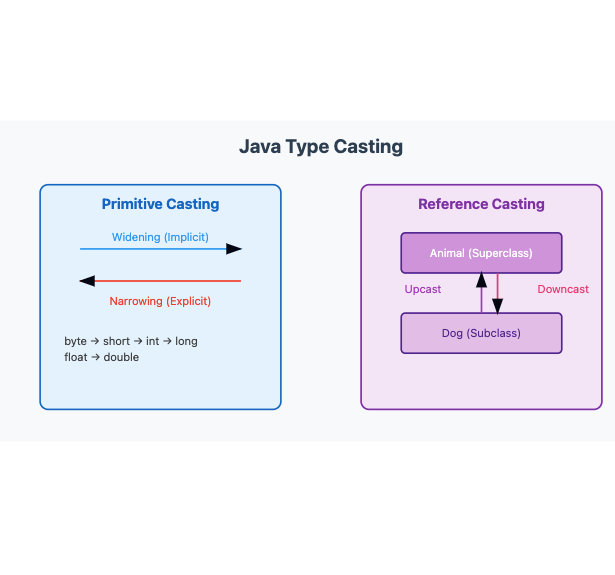
Types of Casting
1. Primitive Type Casting
Primitive type casting involves converting one primitive data type to another. There are two types:
a) Widening Casting (Implicit Casting)
- Automatically converts a smaller data type to a larger one
- No data loss occurs
- No explicit operator required
public class WideningCastExample {
    public static void main(String[] args) {
        // Widening casting examples
        int myInt = 100;
        long myLong = myInt;    // Automatic casting: int to long
        float myFloat = myLong; // Automatic casting: long to float
        double myDouble = myFloat; // Automatic casting: float to double
        System.out.println("Original int value: " + myInt);
        System.out.println("After conversion to long: " + myLong);
        System.out.println("After conversion to float: " + myFloat);
        System.out.println("After conversion to double: " + myDouble);
    }
}
b) Narrowing Casting (Explicit Casting)
- Converts a larger data type to a smaller one
- Requires explicit casting operator
- May result in data loss
public class NarrowingCastExample {
    public static void main(String[] args) {
        double myDouble = 9.78;
        int myInt = (int) myDouble; // Explicit casting: double to int
        System.out.println("Original double value: " + myDouble);
        System.out.println("After conversion to int: " + myInt); // Outputs 9 (decimal part is truncated)
        // Example of potential data loss
        long bigNumber = 1234567890123L;
        int smallerType = (int) bigNumber;
        System.out.println("Original long value: " + bigNumber);
        System.out.println("After conversion to int: " + smallerType); // Data loss occurs
    }
}
2. Reference Type Casting
Reference type casting involves converting between different object types within an inheritance hierarchy.
a) Upcasting
- Converting a subclass reference to a superclass reference
- Always safe and implicit
- Restricts access to subclass-specific members
public class UpcastingExample {
    static class Animal {
        void makeSound() {
            System.out.println("Some sound");
        }
    }
static class Dog extends Animal {
        void makeSound() {
            System.out.println("Woof!");
        }
        void wagTail() {
            System.out.println("Tail wagging");
        }
    }
    public static void main(String[] args) {
        Dog dog = new Dog();
        Animal animal = dog; // Upcasting
        animal.makeSound(); // Calls Dog's makeSound()
        // animal.wagTail(); // Won't compile - method not available in Animal
    }
}
b) Downcasting
- Converting a superclass reference to a subclass reference
- Requires explicit casting
- Can throw ClassCastException if invalid
- Should be used with instanceof operator for safety
public class DowncastingExample {
    static class Animal {
        void makeSound() {
            System.out.println("Some sound");
        }
    }
static class Dog extends Animal {
        void makeSound() {
            System.out.println("Woof!");
        }
        void wagTail() {
            System.out.println("Tail wagging");
        }
    }
    public static void main(String[] args) {
        Animal animal = new Dog(); // Upcasting first

        // Safe downcasting with instanceof check
        if (animal instanceof Dog) {
            Dog dog = (Dog) animal; // Downcasting
            dog.wagTail(); // Now we can call Dog-specific methods
        }
        // Unsafe downcasting example
        try {
            Animal generalAnimal = new Animal();
            Dog impossibleDog = (Dog) generalAnimal; // Throws ClassCastException
        } catch (ClassCastException e) {
            System.out.println("Cannot cast Animal to Dog when the object is not actually a Dog");
        }
    }
}
Best Practices
- Always use instanceof before downcasting
if (object instanceof TargetType) {
TargetType target = (TargetType) object;     // Safe to use target
}
2. Be aware of data loss in primitive narrowing conversions
double pi = 3.14159; int intPi = (int) pi; // Will lose decimal precision3. Use wrapper classes for string to primitive conversion
String numberStr = "123"; int number = Integer.parseInt(numberStr); // Preferred over casting4. Consider using pattern matching (Java 16+)
if (object instanceof Dog dog) {
     // dog is already cast and available
dog.wagTail();
}
Common Pitfalls
- ClassCastException
Object obj = "Hello";
Integer number = (Integer) obj; // Throws ClassCastException
2. Loss of Precision
long bigNumber = 1234567890123L;
float smaller = (float) bigNumber; // Loss of precision
3. Forgetting to Check Types
Animal animal = getAnimal(); // Could return any Animal subtype
Dog dog = (Dog) animal; // Dangerous without instanceof check
Conclusion
Understanding type casting is crucial for Java development. While implicit casting is safe and straightforward, explicit casting requires careful consideration and proper type checking to avoid runtime errors. Always use instanceof checks when downcasting objects and be aware of potential data loss when performing primitive type conversions.
Remember that good design often minimizes the need for explicit casting. If you find yourself doing a lot of casting, consider whether your class hierarchy could be restructured to make the code more type-safe and maintainable.
Comments
Post a Comment